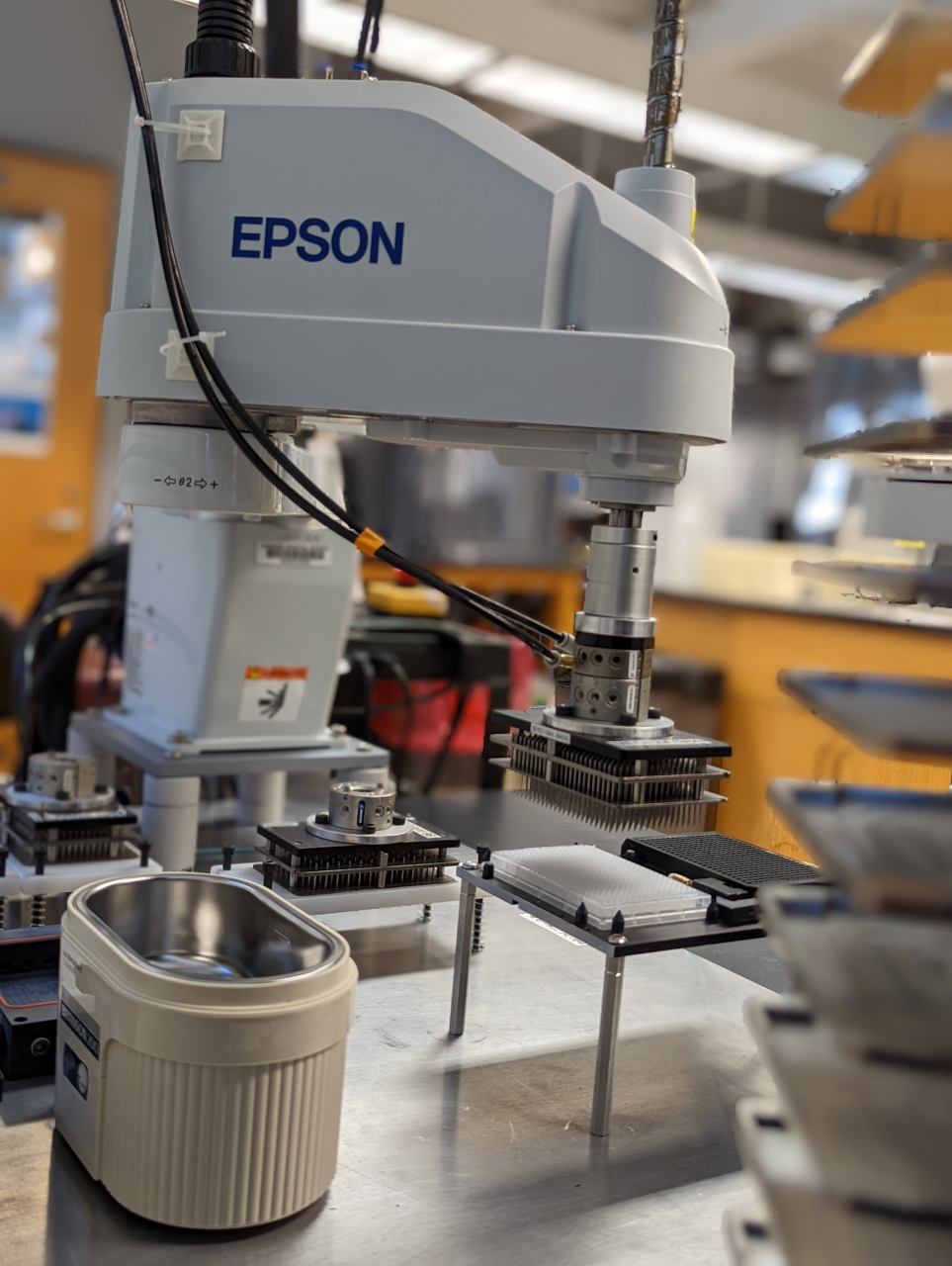
Pin Transfer

Pin Array

ICCB-Longwood utilizes two different robotic platforms to conduct pin transfer of nanoliter volumes from compound storage plates into assay plates using stainless steel pin arrays (made by V&P Scientific).

  • 96- and 384-well pin arrays
  • Transfer compounds into 96-, 384- and 1536-well microplates
  • 384-well assay plate volume 30 uL - calibrated to transfer 33 nL, 100 nL or 300 nL
  • 384-well assay plate volume 10 uL - calibrated to transfer 33 nL or 100 nL
  • The standard transfer volume for chemical screens in 384-well is 100 nL.  
  • 96-well assay plate volume 150 uL - calibrated to transfer 200 nL, 250 nL or 300 nL


Pin Arrays & Calibration provides more information on the pin arrays, the calibration process and selecting the appropriate pin array for your screen.

K2 Compound Transfer Robot (SGM 611)
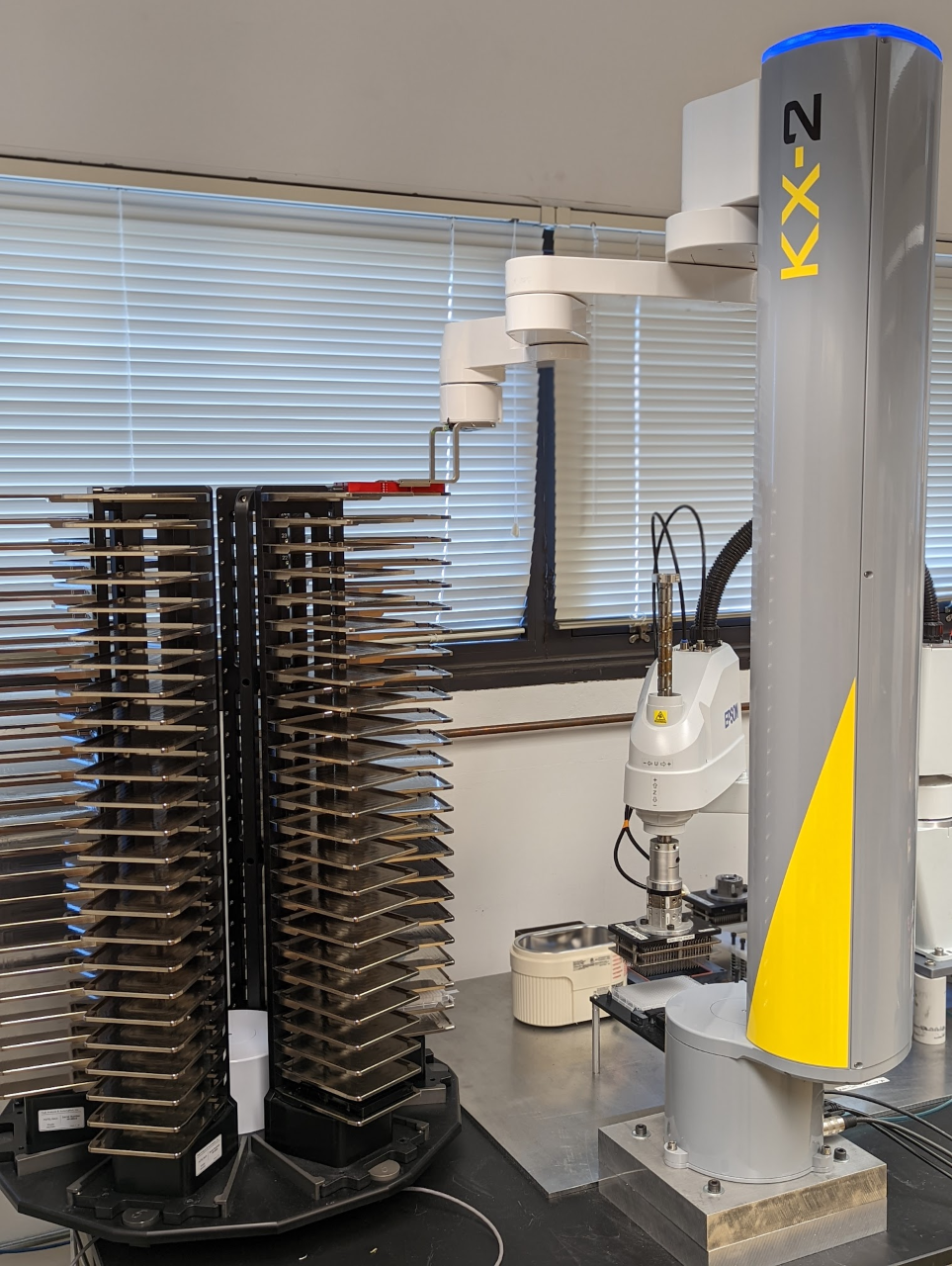
Epson K2 pin transfer robot
  • Custom pin transfer station featuring an Epson T6-602s SCARA robot designed and built at ICCB-Longwood
  • Paired with a Peak Robotics KX2 robot arm to deliver library and assay plates to and from the deck for transfer
  • Automated rotating CS6 carousel for microplate hotel racks
  • Custom Arduino-based relay board with 24V power supply to switch I/O devices
  • Automatic pin tool attachment/detachment

K2 Specifications

DesignRichard Siu
Construction
Richard Siu & Alasdair Morton 
Integration Software
Custom C# .Net Application developed by Richard Siu

Robotic


  • Peak Robotics KX2-750 robot arm
  • Peak Robotics CS6 carousel
  • Epson T6-602s SCARA robot
Table
Custom Designed by SteelSentry
Sonicator
Sonicor SC-50
Methanol Bath
Designed by ICCB-Longwood Team
Dry Station
Designed by ICCB-Longwood Team

Pin Arrays


Manufactured by V&P Scientific.  

  • 33nL
  • 100nL
  • 300nL
Cycle Time
Approximately 1 minute per transfer, including wash and dry
Plate Types Accepted
384-well, 96-well
Total Plate Capacity
150

Pin Array Calibration

The amount of compound transferred is dependent on several parameters

  • Pin shape and diameter
  • Volume of stock solution
  • Rate of pin withdrawal from the stock solution
  • Viscosity of liquid in the assay plate
  • Dwell time in the assay plate

Pin Array Wash

To prevent compound carryover, each pin array is washed after every library transfer.  

Pin Washing Steps:

  • PBS
  • 100% methanol flow-through wash
  • 20% methanol sonication step
  • (repeat twice)
  • Concludes with a 10-second high-pressure air dry

Sonic Compound Transfer Robot (SGM 612)

Sonic Compound Transfer Robot
  • Custom pin transfer station featuring an Epson T6-B602s SCARA robot designed and built at ICCB-Longwood
  • Paired with a Peak Robotics KX2-Plus robot arm to deliver library and assay plates to and from the deck for transfer
  • Automated rotating CS6 carousel for microplate sequential racks
  • Custom Arduino-based relay board with 24V power supply to switch I/O devices
  • Automatic pin tool attachment/detachment

Sonic Specifications

DesignRichard Siu
Construction
Richard Siu & Bryce Carr
Integration Software
 Custom C# .Net Application developed by Richard Siu
Robotics
  • Peak Robotics KX2-Plus-750 robot arm
  • Peak Robotics CS6 carousel
  • Epson T6-B602s SCARA robot
Table
Designed by Richard Siu, manufactured by Vention, assembled by Mitchell Kozakoff, Bryce Carr and Richard Siu
Sonicator
Cole Parmer Ultrasonic Cleaner
Methanol Bath
Designed by Stewart Rudnicki
Dry Station
Designed by Stewart Rudnicki
Pin Arrays

Manufactured by V&P Scientific.  

  • 33nL
  • 100nL
  • 300nL
Cycle Time
Approximately 1 minute per transfer, including wash and dry
Plate Types Accepted
384-well
Total Plate Capacity
~190 (+/- 10 to 20 depending on plate heights)

Pin Array Calibration

The amount of compound transferred is dependent on several parameters

  • Pin shape and diameter
  • Volume of stock solution
  • Rate of pin withdrawal from the stock solution
  • Viscosity of liquid in the assay plate
  • Dwell time in the assay plate

Pin Array Wash

To prevent compound carryover, each pin array is washed after every library transfer.  

Pin Washing Steps:

  • PBS
  • 100% methanol flow-through wash
  • 20% methanol sonication step
  • (repeat twice)
  • Concludes with a 10-second high-pressure air dry